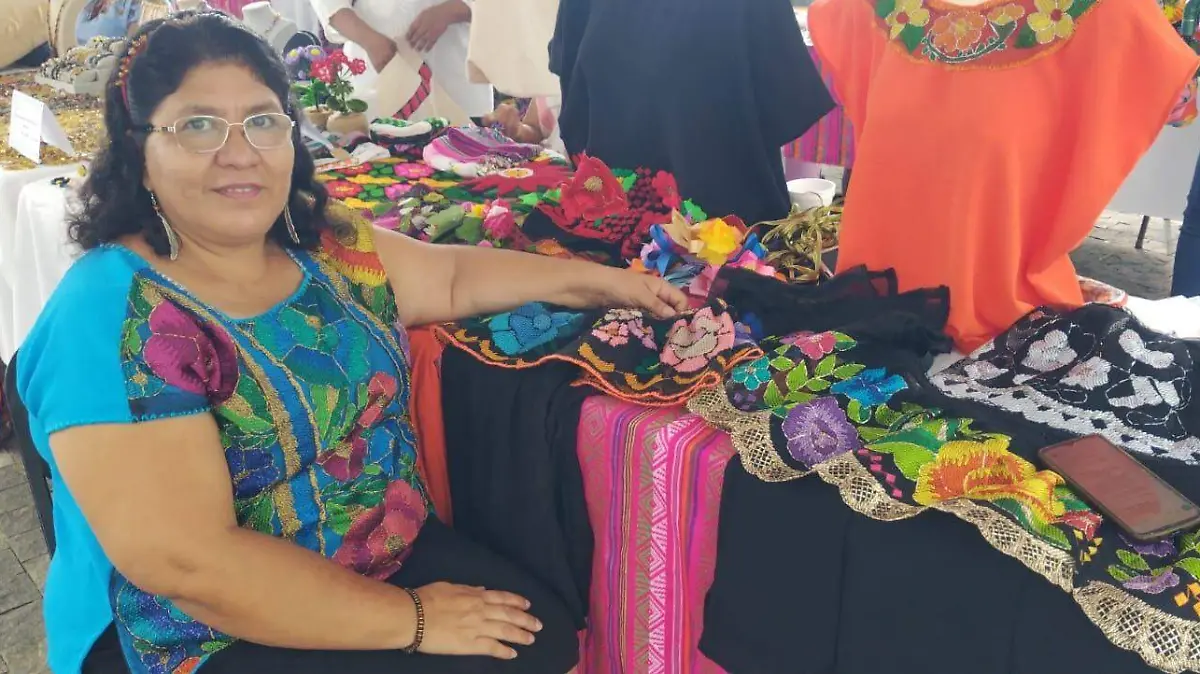
Marlene de Coss, originally from Chiapa de Corzo and living in Ixtapa, is an artisan dedicated to the creation of hand-embroidered textiles, an activity that has shaped her entire life. She began learning this craft at the age of six, and next January she will celebrate 50 years of embroidery. For Marlene, this activity is much more than a job; it’s occupational therapy, where threads, needles, and the backstrap loom become her passion. Currently, she represents the third generation of a family of Chiapas embroiderers.
Since she was a child, Marlene remembers how her mother encouraged her to practice embroidery before playing: “My mother wouldn’t let me go out to play without first embroidering a ruffle on the chiffon blouse. As a child, I didn’t understand it, but in my youth, I began to value each garment and the teachings of my teachers.”
The artisan recalls that her elementary school teachers significantly contributed to her development. “I was fortunate that my first and second grade teacher instilled in me a love of art. In fourth grade, another teacher reinforced my knowledge, and in fifth and sixth grade, Octavio Ovando taught me flower drawings, which I perfected through high school. This is how my passion for Chiapas crafts grew.”
Marlene emphasizes that every stitch of her embroidery and each Chiapas dress, which is her signature product, reflects the cultural richness of Chiapas. “Each thread and each garment tells a story we share as artisans. For us, embroidery is an encounter with nature and a way to preserve the legacy of our ancestors,” she explains.
Among her most notable pieces are the Chiapas dresses, handmade using traditional techniques and different types of threads, such as silk and yarn. These dresses consist of two pieces: the skirt, made of flounce, satin, or baize fabric, in colors such as black, yellow, light blue, red, and other shades, and the blouse embroidered with floral and animal designs. The artisan states: “Each garment is thought of and crafted with love. The designs emerge at night, capturing stories and memories. A dress can cost from 3,500 to more than 20,000 pesos, depending on the complexity of the embroidery.”
Furthermore, Marlene emphasizes that hand embroidery is an occupational therapy that accompanies all stages of life. “As women, we must find activities that fulfill us and allow us to feel fulfilled. It’s not just about working, but about enjoying the process and giving value to what we do,” she comments.
Finally, the artisan emphasizes the importance of learning and appreciating ancestral trades, passing on the richness of Chiapas craftsmanship from generation to generation, which combines technique, creativity, and passion in each embroidered thread.
Source: oem