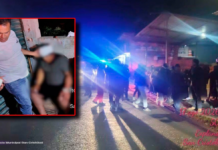
Isabel Torres, leader of the Searching Mothers of Chiapas collective, described the Mexican government’s response to the recent report by the UN Committee against Enforced Disappearances (CED) as a “mockery” and an attempt to “normalize the tragedy.”
“They feign peace, but the disappearances continue. It has been the same government and the same Attorney General’s Office that take them and make them disappear,” Torres stated during the awareness campaign that the collective holds every first Sunday of the month in the Chiapas capital.
As they do on the first of every month, the mothers went to the San Marcos Cathedral, where they met with Archbishop José Francisco González González, who provides them with spiritual support.
In the cathedral’s courtyard, they set up a “clothesline of cards” displaying the faces of their sons and daughters, a stark reminder of the absence that plagues the state.
Given the government’s stance rejecting the findings of the international organization, the mothers’ collective insisted on the need for the UN Special Committee on Enforced Disappearances (CED) to have full access to investigations within Mexican territory.
“Since last year, we have been requesting the support of the UN. We met with Special Rapporteur Mary Lawlor last January in San Cristóbal de Las Casas, and we continue to demand what is rightfully ours by law: the State’s obligation to search for our disappeared loved ones,” the leader stated.
Isabel Torres denounced that, despite the official discourse on security, the municipality of Berriozábal has become one of the localities with the highest incidence of enforced disappearances.
According to the collective’s records, between September and October of 2025 alone, 55 disappearances were recorded in a four-month period, primarily affecting young people between the ages of 15 and 30.
“Berriozábal ranks eleventh in disappearances; it’s a red zone. The government maintains its slogan that there is peace in Chiapas, when the reality for families is absence,” she criticized.
The crisis became tangible on April 1st, when the group located skeletal remains in a federal reserve on the border between Berriozábal and Tuxtla Gutiérrez. The discovery was made possible thanks to an anonymous tip and the support of the State Search Commission.
However, Torres recounted that personnel from the State Attorney General’s Office (FGE) arrived at the site three hours later to secure the remains. To date, the agency has not provided any information about the results of the forensic examinations or the victim’s identity.
The Searching Mothers of Chiapas collective currently comprises more than 30 families. Of this group, at least a dozen have not filed a formal complaint with the Public Prosecutor’s Office for fear of reprisals. In these cases, the collective channels the information to the Search Commission to generate bulletins that allow the search to begin without legally exposing the families in the first instance.
Among the faces displayed on the clothesline is that of Josefina Ramírez Pérez, 33. She is searching for her son, Hernán Lira Ramírez, who was 15 years old when he disappeared on August 1, 2024, in Berriozábal.
Hernán worked with his father at the municipal slaughterhouse. That day, he left on his motorcycle to meet some friends and never returned. Today, Josefina can barely speak; the pain, her fellow searchers agree, has overwhelmed her for almost two years, while the echo of “official peace” contrasts sharply with the silence of the investigation files.

Source: proceso