
First District Judge Doris Yadira Ponce Figueroa denied the provisional and definitive suspension requested by Indigenous peoples and communities to halt construction of the Palenque-San Cristóbal Highway, which began on June 8, according to lawyers and groups supporting the plaintiffs.
They also announced that 429 individuals and 33 civil society and academic organizations from 25 countries expressed their support for the Indigenous communities and peoples who oppose the highway’s construction.
Regarding the injunction, they added that the judge “argued that the plaintiffs failed to prove the alleged omission, without examining the merits or considering that the nature of the failure to provide information is a burden of proof that the government must overcome, not the plaintiffs.”
They stated that for now, the process is suspended “until a complaint filed by the Chiapas State Infrastructure Secretariat against the admission of the injunction claim is resolved.”
They stated that a review appeal filed by the complainants against the denial of the definitive suspension of the project is pending resolution. This appeal will be heard by the Circuit Court for Administrative Matters of the State of Chiapas.
“At this time, the District Judge’s decisions denying the provisional and definitive suspension leave the indigenous communities defenseless, as it allows the highway to continue its course without the affected people having accurate and adequate information about the details of the project and the impact it will have on their territories and their culture,” they stated.
They asserted that “this represents irreparable damage to the territory and the environment, as the District Judge has failed to recognize the relationship between the right of access to timely environmental information in public consultation processes and environmental destruction.”
They stated that “the Court dismissed the injunction without examining the merits, because it considered that the decree by which the State Executive establishes guidelines for conducting consultations on megaprojects did not, in and of itself, violate the rights of Indigenous peoples and communities.”
They added that the Second District Judge, Ana Luis Mendoza Álvarez, responsible for hearing the injunction regarding the guidelines, “did not take into account the arguments that the decree does not contemplate human rights standards regarding the right to Indigenous consultation. A decision made by a show of hands by people outside the affected communities, without information or dialogue sessions, does not constitute a consideration of the voice of the people.”
They emphasized that “the dismissal of the injunction represents a wasted opportunity for the Court to establish novel and important judicial criteria regarding the right to development and self-determination from the perspective of Indigenous peoples and communities: Is a highway development for them? Or perhaps they want and need other infrastructure projects such as schools or hospitals in their territories? Were they asked?”
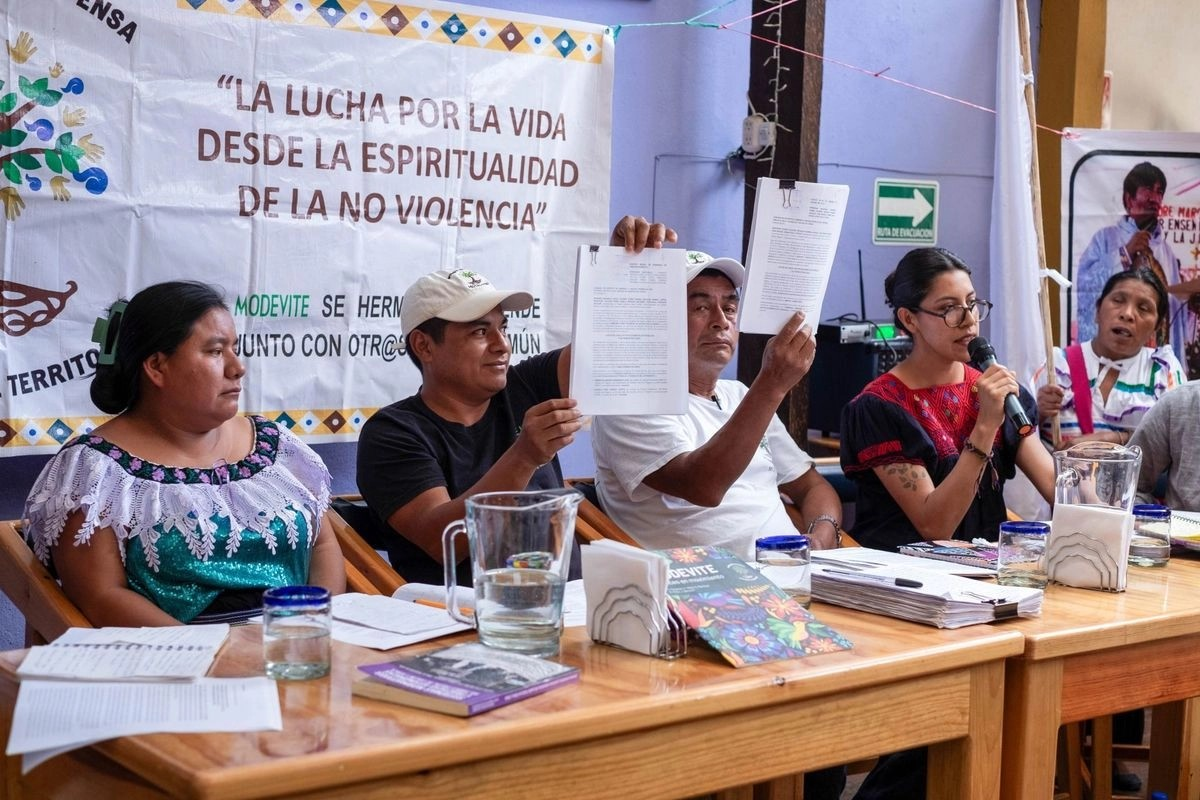
The lawyers and reporting groups also announced that 429 individuals in solidarity and 33 civil society and academic organizations from 25 countries, including Mexico, the United States, Canada, Colombia, France, Germany, Argentina, and Brazil, joined the Declaration of Territories Free of Megaprojects, signed by 12,516 Indigenous people from the municipalities that will be affected by the highway.
“The 429 individuals and 33 organizations signed the declaration in response to a series of omissions by the state government, headed by Eduardo Ramírez, regarding the public consultation process and the publication of the Environmental Impact Statement. They stated they fully support ‘the actions and mechanisms of the peoples of Chiapas to protect what belongs to them.’”
They also demanded that the state and federal governments respect the right to self-determination and information through free, prior, and culturally appropriate consultation, as well as stop the criminalization and violence against environmental and territorial human rights defenders.”

Source: jornada