In the context of the country’s pacification, with military units from the Mexican Army and the nascent Pakal public security force, the Chamula Cartel is consolidating its position as the dominant regional group in Chiapas. Consumers of crystal meth, a “cheap” and easily available methamphetamine in the popular neighborhoods on the outskirts of Tuxtla Gutiérrez, know this.
The Chamula Cartel (named after the emergence and settlement of drug traffickers from San Juan Chamula, not the indigenous people themselves), is on everyone’s lips in this state. Residents, merchants, drug users, and taxi drivers, who have a pulse on the streets, reveal how this drug trafficking group spreads its business, primarily involving crystal meth.
In San Cristóbal de las Casas, a woman, a biologist by profession, tells how the Chamulas cut down their rivals with machetes. “They’re strong. There are actions that have reversed the situation, but the Chamulas are strong,” he comments.
Fuerza Pakal
“Today we want to report that there has been no intentional homicides in the city of Tuxtla Gutiérrez for 17 days. The state capital has had no homicides linked to organized crime activities,” is the report given by state prosecutor Jorge Luis Llaven Abarca on Friday during the security committee meeting where the heat maps (the state’s crime mapping) were presented.
Llavan Abarca tells Crónica that this clean toll is due in part to the “dignification of the police,” with better salaries and benefits. Prosecutor Llaven Abarca acknowledges, without ever mentioning the Chamulas, that achieving public safety in the state is a complex task. In the mountains, the need to break into the so-called El Maíz organization became a reality. This organization is made up of residents forced to man checkpoints that prevent police forces from passing. That’s how complex the issue is.
Eight months after Eduardo Ramírez took office as president of Chiapas, the Pakal Immediate Reaction Force (FRIP), an elite security unit, has 700 members, with a base salary of up to 40,000 pesos per month. High-ranking officers earn 80,000 pesos.
“There is a change in the daily lives of the people of Chiapas. People can now travel on the roads, because before Eduardo Ramírez came to power, we merchants who traveled from one municipality to another couldn’t come to Chiapas, we couldn’t open our businesses,” says
a vendor of coffee, wine, and “poxo,” a distilled corn beverage.
But he mentions that the government still faces the challenge of getting Los Chamulas to “stop it.”
Rodolfo, for his part, has clients who seek him out for rides in his taxi to the outskirts of Tuxtla, in the working-class neighborhoods, where less than a year ago, organized crime dispatched nine young dealers with high-powered weapons.
“It’s already under control. It’s said that the Jalisco Nueva Generación Cartel killed them; they’re fighting over territory,” he states confidently. “We can’t deny the government’s intentions, but they’re tough in those neighborhoods. We’re entering because they ask for our services.”
Addiction in the Deep South
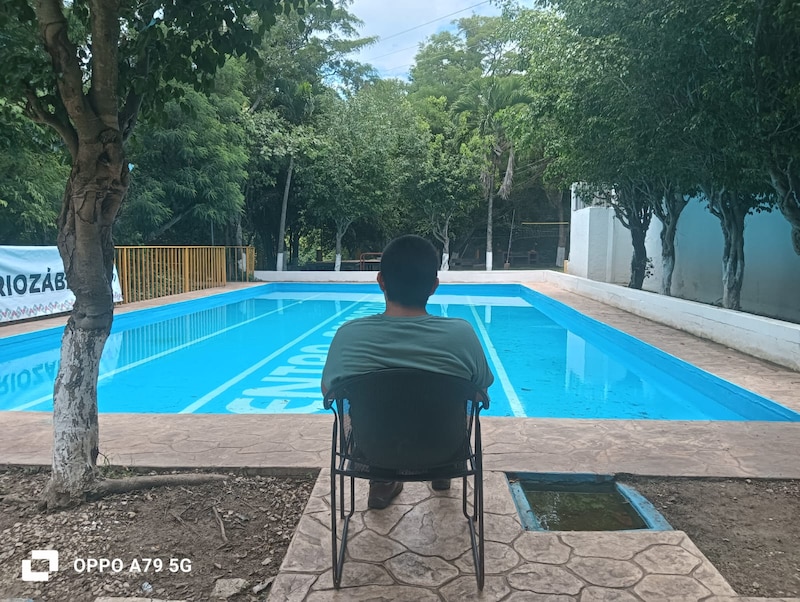
Jesús (a fictitious name to protect his identity) is in a public rehabilitation center located in the municipality of Berriozábal. He rests, looking at the pool (in the accompanying photo) and tells Crónica that he’s just a few days away from leaving this place where he found freedom from addiction.
He recounts his previous experiences: he bought the 30 grams of crystal meth from Los Chamulas in San Cristóbal and formed a white line measuring 52 centimeters. His goal was to snort as much as he could and kill himself that way; he wanted to stop suffering from his addiction. He didn’t die, but instead went to trial for drug possession and an initial hearing where the judge said, “He’s still high,” and ordered treatment for his addiction.
With the support of his father, who first confined him to a cruel annex where the idea of suicide was conceived, he finally learned about the Center for Addiction Prevention and Treatment (Centra), a facility maintained by the state budget and, with the support of the State Attorney General’s Office, aligned with the comprehensive efforts to pacify Chiapas.
“I arrived here after spending 148 hours in jail for possession. I’ve been rehabilitated at Centra, with all the specialists, the activities, the gym, everything. I’ll be out of here this month.”
Jesus is an aging thirty-something, another of the ravages caused by heavy Chamula crystal use. A while ago, he had a metal plate placed in his head, after “flying 42 meters over houses;
I graduated from high school on my motorcycle pretty high. I have mobility problems in one hand. But I didn’t understand and continued using with my girlfriend. She lost a son, and I know she’s out there on the streets, barefoot, addicted.”
“Will you look for her when you leave here?”
“I hadn’t thought about it, but I will look for her so she can be treated…”
Source: cronica