On August 13, the National Institute of Statistics and Geography (INEGI) presented the most recent results on multidimensional poverty in Mexico, corresponding to the year 2024.
To begin, what is meant by multidimensional poverty?
When we talk about multidimensional poverty, we refer to the lack of basic resources for survival, not only a lack of money, but also taking into account other factors, such as access to basic services, education, social security, among other aspects.
Three areas are considered for its measurement:
Economic well-being: This measures the level of income that people have to cover a basic food basket (measured in both urban and rural areas).
Social rights: This measures educational backwardness, access to health services, social security, decent housing, basic services (in the home), and adequate food that is not only tasty but nutritious.
Territorial context: This considers social cohesion (related to the social climate and security) and access to basic infrastructure such as paved roads (even if they have a ton of speed bumps, they count here).
This seeks to understand and explain poverty, and with what we have just outlined, we can measure the deficiencies that people in the country face daily.
Let’s look at the main data at the national level.
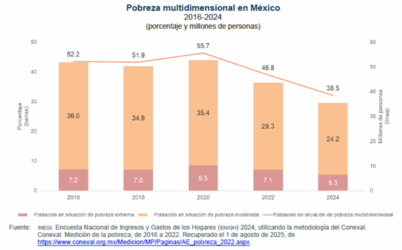
In 2024, 29.6% of the population in Mexico lived in multidimensional poverty, equivalent to 38.5 million people. This data is divided into:
Moderate poverty: 24.2% (31.5 million people). The population in this situation has some resources, but not enough to live with dignity.
Extreme poverty: 5.3% (7.0 million people). This population group lacks virtually all the basic elements necessary for a decent life.
However, compared to 2016, multidimensional poverty fell from 43.2% to 29.6%, representing a decrease of 13.7 million people. Extreme poverty fell by 1.9 percentage points, or 1.8 million people, who escaped or ceased to be in extreme poverty.
How these data affect rural and urban areas
Poverty presents itself differently depending on the location; that is, it is not the same in urban areas as it is in rural areas. This distinction allows us to identify where the greatest gaps or systemic failures in guaranteeing fundamental rights are concentrated.
45.8% of the rural population lives in multidimensional poverty (13 million people).
While in urban areas, the figure drops to 25.0%. (less lag in access to basic basic resources)
What happens if we look at these data at the regional level?
The data presented so far are at the national level, but what about at the state level? Large differences are observed between states, which translate into significant regional inequalities.
The objective here is not to discourage anyone, but rather to highlight some data to ask why, in the south of the country, significant progress has not been made in improving the living conditions of the population. While poverty levels are lower in the north of the country, the situation in the south remains worrying. This is nothing new, but it is worth asking: what factors are preventing the situation from improving? This is where “researchers” should be “working” to explain this situation in detail.
In Chiapas, 66.0% of the population lives in multidimensional poverty, the state with the highest percentage. It is followed by Guerrero with 58.1% and Oaxaca with 51.6%.
These same states also rank highest in extreme poverty: Chiapas with 27.1%, Guerrero with 21.3%, and Oaxaca with 16.3%. Chiapas has the highest percentage of people living in extreme poverty.
Compared to the states with the lowest multidimensional poverty, these are Baja California with 9.9%; Baja California Sur with 10.2%; and the state of Nuevo León with 10.6%. These results highlight persistent regional inequalities.
Chiapas suffers from structural and chronic poverty.
Chiapas continues to be particularly alarming. Not only does it have the highest levels of multidimensional and extreme poverty, it also has the greatest deficiencies in several basic services: nearly 2 million people are behind in education; 3.7 million lack access to health services; More than 4.4 million people lack social security, and more than 1.5 million live in extreme poverty.
The data published by INEGI on multidimensional poverty show significant progress nationwide. However, this progress is not uniform across the country.
The regional inequality between the south and the north, particularly in Chiapas, has the highest levels of poverty, especially in indigenous and rural communities. This reveals once again an uneven structure of development processes; while the federal government’s efforts seem disconnected from regional efforts, there is something about the policies of state and municipal governments that is not being effectively coordinated with federal government policies.

Source: chiapasparalelo