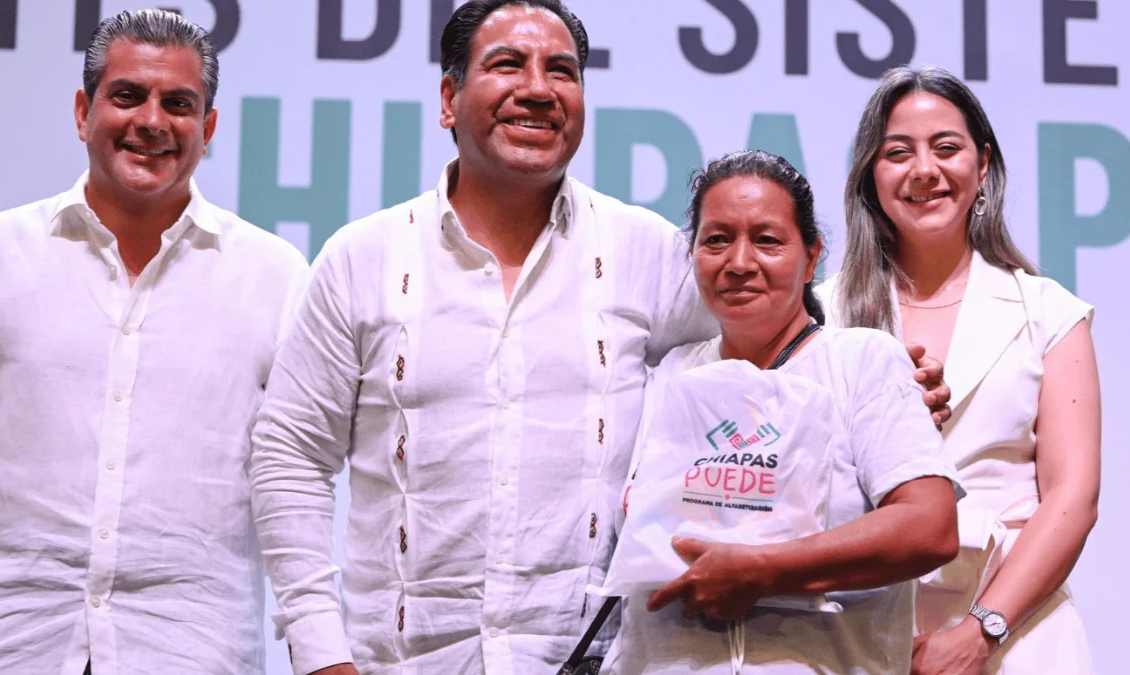

The “Chiapas Puede 2026” program promotes literacy in Chiapas with financial support and an accessible registration process for people over 15 years of age who are behind in their education.
Aline Ruz has 19 years of experience in print and digital journalism, and over a decade of specialization in covering public institutions and social programs in Mexico, including the Federal Electricity Commission (CFE), Welfare Programs, the Mexican Social Security Institute (IMSS), the Institute for Social Security and Services for State Workers (ISSSTE), the Ministry of Welfare, Pemex, the Tax Administration Service (SAT), the Federal Consumer Protection Agency (Profeco), and the Ministry of Public Education (SEP), as well as legislation such as the IMSS Law 73 and Law 97, the 2007 ISSSTE Law, and the Federal Labor Law, among others. Her career includes high-profile coverage, such as the Sarah Brightman concert at Chichén Itzá (2009) and the 2012 and 2024 Mexican federal elections, demonstrating a deep understanding of politics, public administration, and social programs based on field experience. A graduate in Social Communication from the Faculty of Anthropology at UADY, Aline has been recognized for her rigor and credibility, cited by media outlets specializing in social welfare and social security issues, solidifying her authority in the journalistic and legal fields. Her commitment to truthful and reliable information is reflected in her ongoing work, providing expert analysis and trustworthy coverage of the functioning of institutions and laws that impact millions of Mexicans.
The fight against illiteracy in Chiapas has become a priority, promoting social programs that combine basic education and financial support to transform the lives of thousands of people. In this context, “Chiapas Puede 2026” stands out by offering 1,000 pesos per month for learning to read and write, a strategy that seeks to improve opportunities and reduce inequality in vulnerable communities.
In Mexico, access to basic education remains one of the main challenges in some regions of the country, especially in rural and indigenous communities. Lack of literacy not only limits job opportunities but also impacts people’s ability to fully exercise their rights, access services, and make informed decisions in their daily lives.
In this context, states like Chiapas have implemented specific strategies to combat educational inequality. According to data from the National Institute of Statistics and Geography (INEGI), the state has one of the highest illiteracy rates in the country, which has led to the implementation of programs focused on teaching reading and writing to young people and adults.
The “Chiapas Puede” (Chiapas Can) program provides a monthly stipend of 1,000 pesos for up to four months to people over 15 years of age. Registration is done through community centers and official announcements, where interested individuals must go to join the literacy program.
To register, people must meet basic requirements such as being over 15 years old and not knowing how to read or write. The process begins with registration in their community, where program staff collect their information and integrate it into the corresponding system.
Once accepted, beneficiaries receive free educational materials and are assigned to a study group with an advisor who guides their learning, using the “Matías de Córdova” model, with an intercultural approach adapted to indigenous languages.
The program also includes the use of the Comprehensive Literacy Management System (SIGA), a digital tool that allows for monitoring each participant’s progress and ensuring the educational process is completed.
In addition to the financial incentive, learning to read and write provides key benefits such as understanding official documents, accessing social programs, supporting their children with schoolwork, and improving their quality of life.
With “Chiapas Puede 2026” (Chiapas Can 2026), the state is reinforcing its support of 1,000 pesos per month for literacy programs, facilitating registration at local centers and promoting literacy as a foundation for social development and reducing educational inequality.
Source: mibolsillo