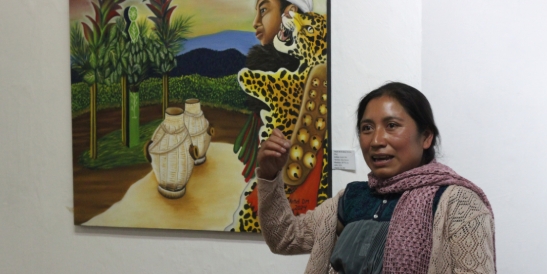

Tsotsil artist Antel DM, originally from San Juan Chamula, is presenting her first solo exhibition in San Cristóbal de Las Casas.
For decades, San Juan Chamula, in Chiapas, has often been reduced to racist stereotypes that have obscured the cultural and artistic richness of its people. Challenging that narrative, Tsotsil painter Antel DM has built an artistic vision that celebrates the memory, spirituality, and everyday life of the Maya communities of the Chiapas Highlands.
Originally from the community of Tentic, in San Juan Chamula, Antel DM belongs to a new generation of Indigenous women who have turned artistic creation into a form of cultural resistance against centuries of discrimination and colonialism.
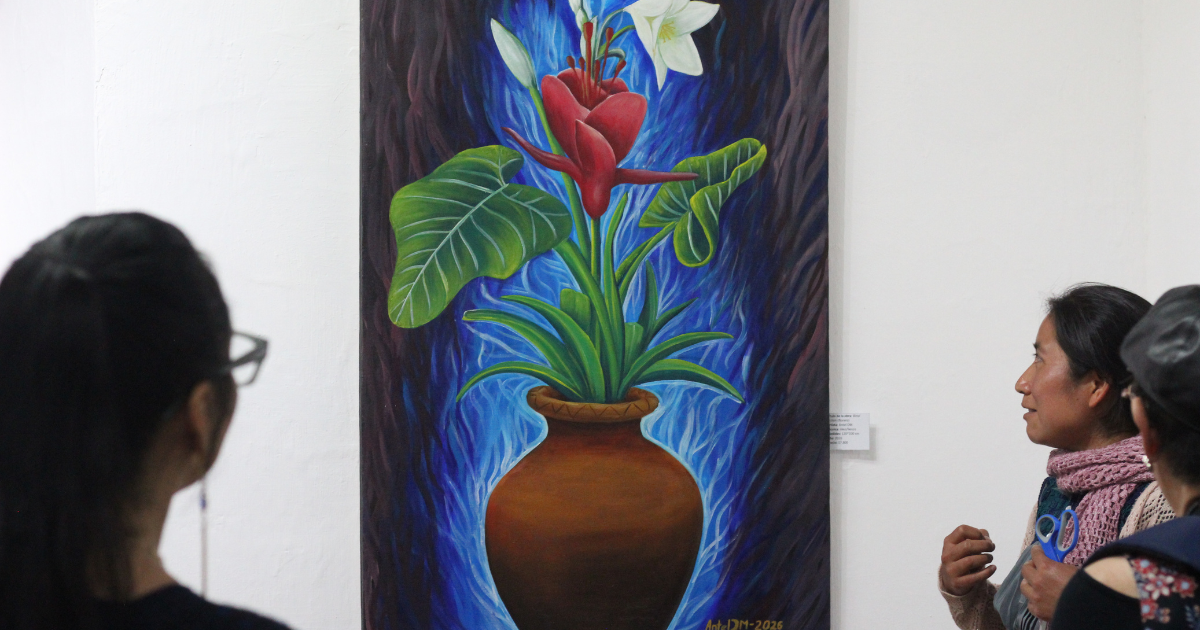
Her first solo exhibition in San Cristóbal de Las Casas features a collection of works portraying community life through a perspective deeply rooted in the Tsotsil worldview.
Painting Through the Experience of Being a Maya Woman
Before becoming a painter, Antel DM grew up caring for sacred sheep, making tortillas alongside her mother and sisters, weaving wool, and working the land.
Rather than limiting her, these experiences became the foundation of her artistic language.
Her paintings depict women carrying out everyday tasks, children wearing traditional clothing, religious ceremonies, mountains, native vegetation such as bromeliads, and ancestral symbols that continue to endure through time.
Antel DM began painting consistently in 2018 as a self-taught artist while respecting the rhythms of community life. That same year, she publicly exhibited one of her first works during the International Women’s Day celebration organized by the Chamula Community Hospital.
The painting portrayed a Tsotsil woman carrying her baby on her back alongside a message written in her native language:
“I have the ability, I have reason, I have feet, I have hands… just like you.”
The message became a powerful affirmation of dignity in the face of the discrimination that Indigenous women have historically experienced.
Art, Research, and the Preservation of Ancestral Memory
In addition to painting, Antel DM is also involved in cultural research.
One of her most recent projects, “Yaya-tot: Pre-Hispanic Ancestral Gods in the Contemporary Traditions of Chamula, Chiapas,” documents the survival of ancient Maya deities within the saints and virgins currently venerated in the Church of San Juan Chamula.
Her research explores the connections between the Maya agricultural calendar, community ceremonies, traditional systems of civic and religious responsibilities, and celebrations that have endured nearly five centuries of colonization.
Unlike many anthropological studies conducted from an outsider’s perspective, Antel DM documents these sacred traditions through painting, honoring ceremonies that cannot be photographed.
Inspiring New Generations of Indigenous Artists
Beyond her own artistic work, Antel DM leads workshops for children and young people in her community.
As a cultural promoter, she teaches painting and sculpture to new generations, believing that access to art should be built collectively.
Her education did not come from formal art schools or institutional scholarships, but from self-directed learning and knowledge shared within her community.
Among the artists who have inspired her are Juan Gallo, the first Tsotsil painter she met as a teenager, and Enriqueta Lunez, a leading contemporary poet writing in the Tsotsil language.
A New Generation of Women Is Transforming Chamula’s Art Scene
Antel DM’s career is part of a broader movement of Indigenous women artists who are reshaping the cultural landscape of the Chiapas Highlands.
Among them are Lucía Patishtán López, Clere López, Elena Lunez, Sofía del Carmen López Gómez, and Rosa María López Gómez, many of whom are connected with the independent cultural center Artex, an organization dedicated to promoting artistic creation in San Juan Chamula.
Through their work, these artists challenge folkloric stereotypes of Indigenous peoples and place the voices and experiences of their own communities at the center of contemporary artistic expression.
Source: cimacnoticias